Romance Fraud Statistics: Three Years of FBI Complaint Data
FBI complaint totals rose from 17,910 in 2024 to 23,159 in 2025. The original category is broader than dating-app fraud.
The FBI recorded $929.3 million in reported losses in its Confidence/Romance category in 2025. The agency accepts international submissions and groups several ways of gaining someone’s trust under that heading. These figures measure complaints and reported losses, not the likelihood that a particular match is a scammer.
What changed from 2023 to 2025?
The figures below come from the FBI Internet Crime Complaint Center’s 2025 report, pages 25–26. The dollar amounts are reported losses in nominal U.S. dollars. A complaint can involve circumstances outside dating, including an impersonation of a friend or relative.
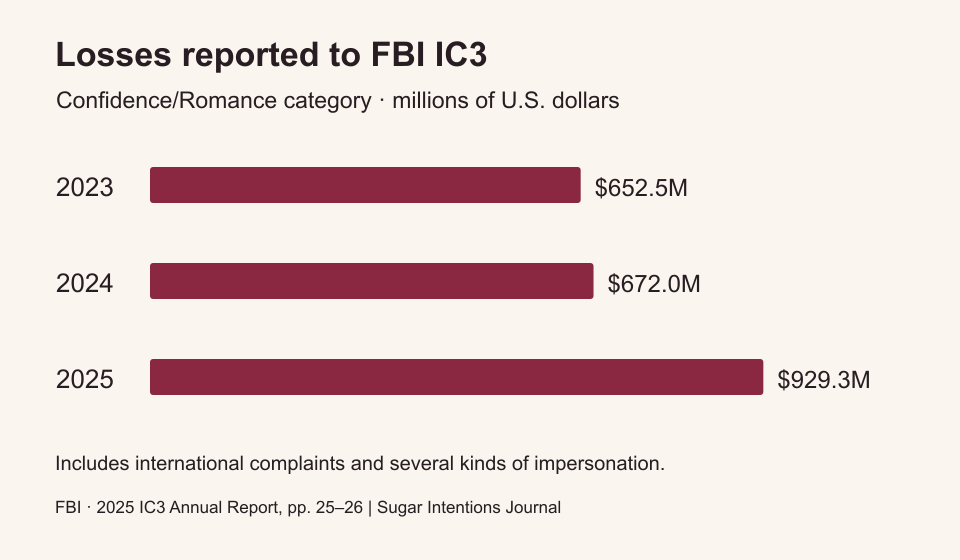
| Year | Complaints | Reported losses (USD) |
|---|---|---|
| 2023 | 17,823 | $652,544,805 |
| 2024 | 17,910 | $672,009,052 |
| 2025 | 23,159 | $929,287,469 |
Sources: FBI Internet Crime Complaint Center
What if a match sends a verification or payment link?
An FBI advisory describes dating contacts who direct people to a supposed free verification service that collects payment details and enrolls them in recurring charges. Open the dating site yourself and use its own account settings. A match does not need a code, card number or fee from you.
If you paid, contact your bank, card issuer or payment provider promptly and explain what happened. Keep the original messages and transaction reference, report the profile, and use the FTC’s guidance for the payment method you used.
Sources: FBI Internet Crime Complaint Center · Federal Trade Commission · Federal Trade Commission
Using the table or figure
Use the label “FBI IC3 Confidence/Romance complaints” with the years shown. The figure and CSV share the same three annual observations as the table. For a publication, cite the original IC3 report and include the scope alongside the chart.
Sources: FBI Internet Crime Complaint Center
Read the original sources.
Public information was checked on November 19, 2026. Features, offers and policies can change. Our product guidance links to the current Sugar Intentions policies.
- 2025 IC3 Annual Report, three-year tables, pages 25–26FBI Internet Crime Complaint Center
- Social media fraud, methods and 2025 reported lossesFederal Trade Commission
- Online verification schemes target dating usersFBI Internet Crime Complaint Center
- What to do if you were scammedFederal Trade Commission
- Report fraud to the FTCFederal Trade Commission
What the FTC can tell us about social media
The FTC’s April 2026 analysis found that nearly 60% of 2025 romance-scam loss reports with a specified contact method began on social media. Its calculation excludes unknown channels and write-in “other” responses. Reported romance-scam losses from contacts on social media were $298 million. The FTC also notes a collection interruption during the 2025 government shutdown.
The FTC and FBI publish different reporting systems. Adding their figures together could count overlapping experiences and would mix different definitions. Neither source identifies a rate for Sugar Intentions members or for sugar dating as a category.
Sources: Federal Trade Commission